Assigned Reading on the Syntax of Expressions
This work is to be done before Exam 1.
Read Sections 2.1 and 2.2 on pp. 28 – 33 of Sethi (up to and including the figure at the top of p. 33).
A. Problems from Sethi
Section titled “A. Problems from Sethi”Do problems 2.1, 2.2, 2.3, 2.7, and 2.8 on pp. 49 – 50 of Sethi.
Problem 2.1:
Rewrite the following expressions in prefix notation. Treat sqrt as an operator with one argument.
-
(a)
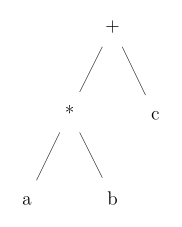
a * b + cSolution
+ * a b c -
(b)
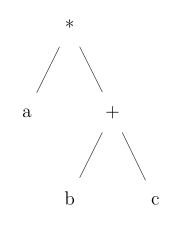
a * (b + c)Solution
* a + b c -
(c)
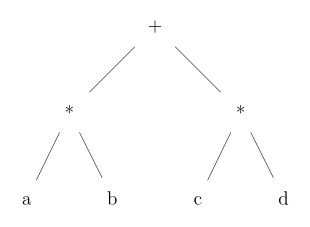
a * b + c * dSolution
+ * a b * c d -
(d)
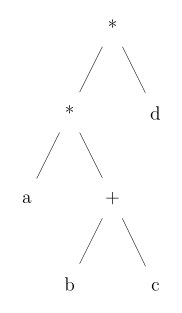
a * (b + c) * dSolution
* * a + b c d -
(e)
Solution
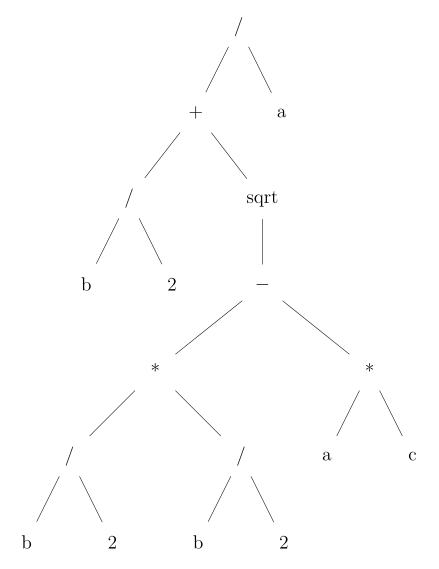
/ + / b 2 SQRT - * / b 2 / b 2 * a c a
Problem 2.2:
Rewrite the expressions of Exercise 2.1 in postfix notation
Solution
(a) a b * c +(b) a b c + *(c) a b * c d * +(d) a b c + * d *(e) b 2 / b 2 / b 2 / * a c * - SQRT + a /Problem 2.3:
Draw abstract syntax trees for the expressions in Exercise 2.1
Solution
(a) Abstract Syntax Tree:
(b) Abstract Syntax Tree:
(c) Abstract Syntax Tree:
(d) Abstract Syntax Tree:
(e) Abstract Syntax Tree:
Problem 2.7:
Draw abstract syntax trees for the expressions in Exercise 2.6 (listed below):
-
(a)
-
(b)
-
(c)
-
(d)
-
(e)
Solution
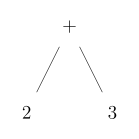
(a,b) Abstract Syntax Tree:
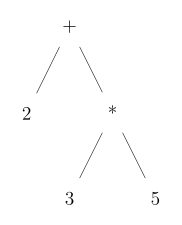
(c,e) Abstract Syntax Tree:
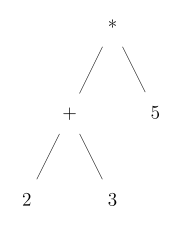
(d) Abstract Syntax Tree:
Problem 2.8:
Postfix expressions can be evaluated with the help of the stack data structure, as follows:
- Scan the postfix notation from left to right.
- a. On seeing a constant, push it onto the stack.
- b. On seeing a binary operator, pop two values from the top of the stack, apply the operator to the values, and push the result back onto the stack.
- After the entire postfix notation is scanned, the value of the expression is on top of the stack.
Illustrate the use of a stack to evaluate the expression 7 7 * 4 2 * 3 * −.
Solution
Stack evaluation of 7 7 * 4 2 * 3 * -:
Stack Remaining Input───────────── ────────────────── 7 7 * 4 2 * 3 * -7 7 * 4 2 * 3 * -7 7 * 4 2 * 3 * -49 4 2 * 3 * -49 4 2 * 3 * -49 4 2 * 3 * -49 8 3 * -49 8 3 * -49 24 -25B. Infix, Prefix, and Postfix Syntax Exercises
Section titled “B. Infix, Prefix, and Postfix Syntax Exercises”Problem 1: Operator Precedence and Abstract Syntax Trees
Section titled “Problem 1: Operator Precedence and Abstract Syntax Trees”In a certain language expressions are written in infix syntax. The language has binary, prefix, and postfix operators that belong to the following precedence classes:
| Precedence Class | Symbol | Binary Ops | Prefix Ops | Postfix Ops | Associativity |
|---|---|---|---|---|---|
| 1st Class (highest) | # | ~ | ~ | [none] | right |
| 2nd Class | @ | [none] | [none] | $ | left |
| 3rd Class (lowest) | % | ^ | @ | [none] | right |
Problem 1(a): Say which operator is applied last in the following expression, and then draw the abstract syntax tree of the expression. [To help you, subscripts have been attached to each operator to indicate its precedence class and whether that class is left- or right-associative, even though this information can also be obtained from the above table.]

Solution
The operator % is applied last.
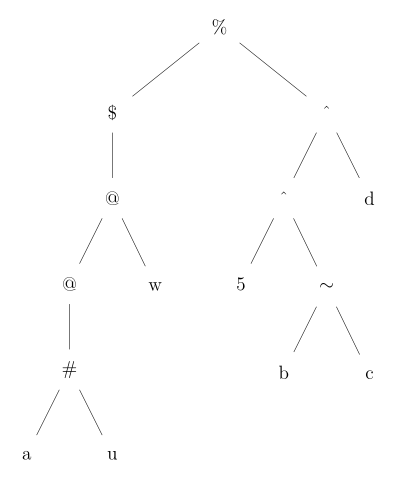
Problem 1(b): Rewrite the expression in prefix syntax.
Solution
% $ @ @ # a u w ^ ^ 5 ~ b c dProblem 1(c): Rewrite the expression in postfix syntax.
Solution
a u # @ w @ $ 5 b c ~ ^ d ^ %Problem 2: Postfix to Prefix Conversion
Section titled “Problem 2: Postfix to Prefix Conversion”Draw the AST of the following postfix syntax expression, and rewrite the expression in prefix syntax. A subscript has been attached to each operator that shows the operator’s arity. [The operators in this question and the next are not related to the operators in question 1.]

Solution
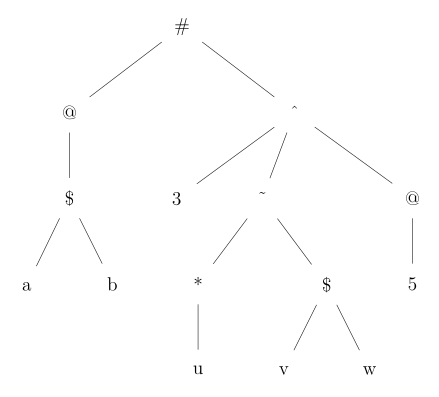
Prefix syntax:
# @ $ a b ^ 3 ~ * u $ v w @ 5Problem 3: Prefix to Postfix Conversion
Section titled “Problem 3: Prefix to Postfix Conversion”Draw the AST of the following prefix syntax expression, and rewrite the expression in postfix syntax. A subscript has been attached to each operator that shows the operator’s arity.

Solution
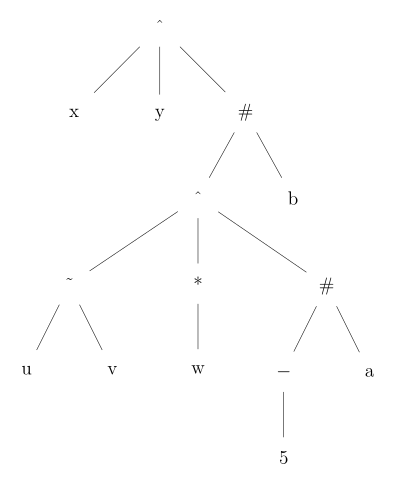
Postfix syntax:
x y u v ~ w * 5 - a # ^ b # ^