CSCI 370 Lec 20: Software Testing and Testable Software
Regression Testing
Section titled “Regression Testing”- Definition: Bugs in software that were fixed reappear.
- Process:
- Identify the bug.
- Fix the bug.
- Create a test for the bug.
- Continuously run the test to ensure the bug does not return.
- Tools: Automated testing software is often used to simplify this process.
Test-Driven Development (TDD)
Section titled “Test-Driven Development (TDD)”- Definition: Write tests before writing the code.
- Steps:
- Red Light: Write a test that fails because the code does not exist yet.
- Green Light: Write the code to make the test pass.
- Refactor: Clean up the code while ensuring the test still passes.
- Advantages:
- Tests run automatically with every code check-in.
- Tests return clear results (true/false).
- Encourages developers to focus on the code they are about to write.
- Ensures that every piece of code has a corresponding test.
- Provides quick feedback and increases confidence in the code.
- Facilitates continuous integration.
Five Stages of Testing
Section titled “Five Stages of Testing”-
Development Testing:
- Includes unit testing (TDD), component testing, and system testing.
- Focuses on finding bugs and defects.
-
Component Testing:
- Tests interactions between related groups of objects.
-
System Testing:
- Tests the entire system as a whole.
- Focuses on component interactions and finding defects like crashes or incorrect computations.
-
Release Testing:
- Conducted by a separate team to validate that the system meets stakeholder requirements.
- Types:
- Alpha Testing: Early testing by a small group of users.
- Beta Testing: Wider testing by a larger group of users.
- Acceptance Testing: Final testing by customers to decide if the software is ready for deployment.
-
User Testing:
- Performed by end-users in their own environment.
Testing Techniques
Section titled “Testing Techniques”Partition Testing
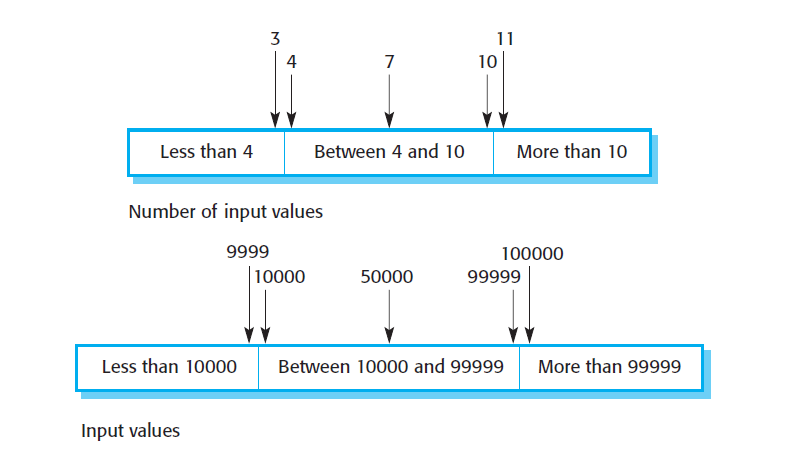
Section titled “Partition Testing”- Identify groups of inputs with common characteristics.
- Focus on edge cases (e.g., maximum and minimum values).
Example:
assertTrue(add(1, 2) == 3);assertTrue(add(Integer.MAX_VALUE, -1) == Integer.MAX_VALUE - 1);assertTrue(add(Integer.MAX_VALUE, 1) == Integer.MIN_VALUE); // Overflow testGuideline-Based Testing
Section titled “Guideline-Based Testing”- Use experience to identify common errors.
- Examples:
- Overwhelming the system (e.g., ordering 10,000 items).
- Passing null values to methods.
Black-Box vs. White-Box Testing
Section titled “Black-Box vs. White-Box Testing”- Black-Box Testing: Test without knowledge of the internal code.
- White-Box Testing: Test with full knowledge of the internal code.
Testable Software
Section titled “Testable Software”-
Methods Should Return a Value:
- Avoid void methods as they are harder to test.
-
Predictable Results:
- Avoid randomness in methods.
-
Environment Independence:
- Software should not rely on specific hardware or environments.
- Example: Self-driving car software can be tested without a physical car.
Continuous Integration and Pipelines
Section titled “Continuous Integration and Pipelines”- Definition: Automate the process of integrating code changes and running tests.
- Goal: Minimize lag time between code check-in and feedback.