Lec 04-16-2026: Scalar Multiplication & Vector Subtraction | MATH 245
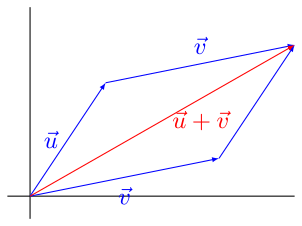
In our last lecture, we ended off with vector addition (tail-to-tip). Before we discuss vector subtraction, we’ll discuss scalar multiplication.
What does it mean to multiply a vector by a number? Intuitively, it should stretch or shrink the vector - and possibly flip its direction.
Def: Given a vector u=[xy]∈R2, and a real number c, we define the scalar multiple of u by c, denoted by cu, to be
cu=[cxcy]
Ex: Suppose u=[11]. Find 2u, 3u, 21u, −u.
2u=2[11]=[22]3u=3[11]=[33]
21u=21[11]=[2121]−u=−1u=−1[11]=[−1−1]
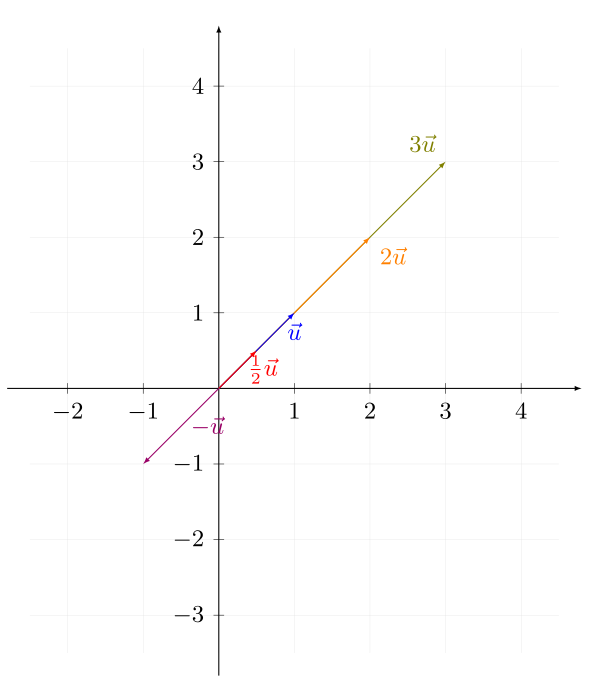
Geometrically, what does cu do to u? Let’s plot the vectors above.
Geometrically, multiplying by a positive scalar c>0 stretches or shrinks u while keeping it on the same ray - all of u, 2u, 3u, 21u point in the same direction. Multiplying by c<0 reverses the direction and scales by ∣c∣, so −u points exactly opposite to u with the same length.
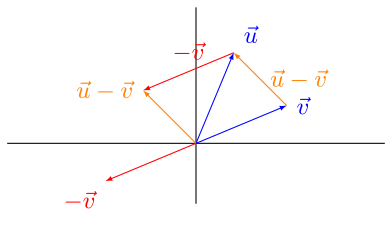
Since vector subtraction is defined as u−v=u+(−1)v, we can compute it by combining scalar multiplication and vector addition. Here is a worked example that mixes both operations.
Geometrically, we understand vector addition (Tail-to-Tip method from last time). Since u−v=u+(−v), vector subtraction is: negate v (flip its direction), then add tail-to-tip.
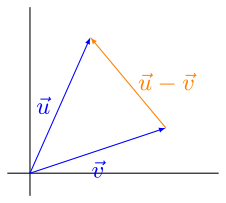
Taking both diagrams together, we get a cleaner geometric interpretation of u−v:
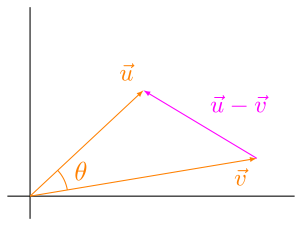
If we have two vectors u & v whose initial point is the origin, then u−v is the vector whose initial point is the tip of v & terminal point is the tip of u. In other words, u−v points from the tip of v to the tip of u.
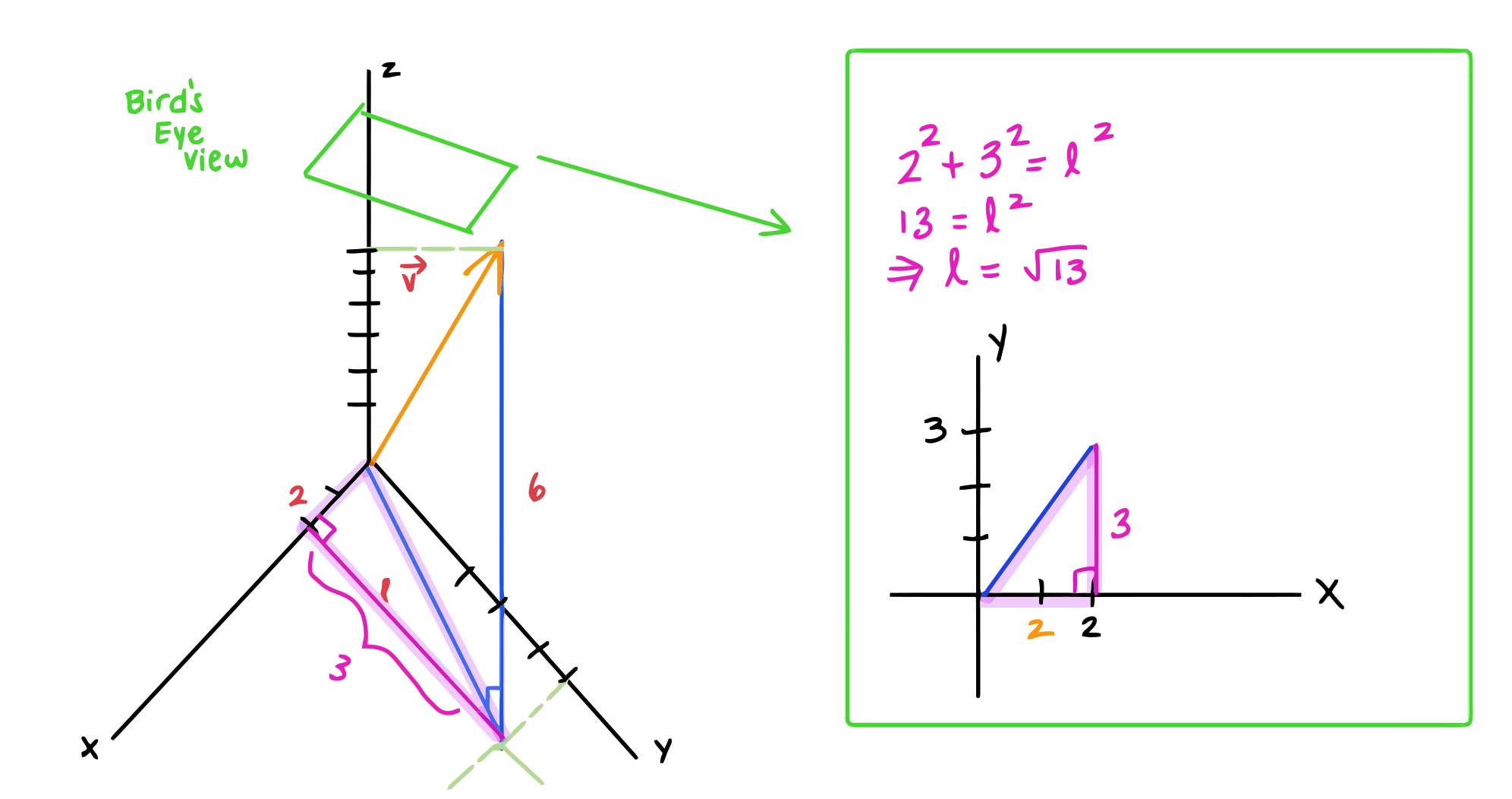
The strategy is to apply the Pythagorean Theorem twice. First, look straight down (bird’s eye view) at the xy-plane and find ℓ, the length of the horizontal leg:
22+32=ℓ2⟹ℓ=13
Now treat the full vector as the hypotenuse of a right triangle with legs ℓ and 6 (the z-component), and apply the Pythagorean Theorem again:
So ∥cv∥=∣c∣∥v∥ - scaling a vector by c scales its length by ∣c∣. This confirms our earlier geometric intuition: when c>0, the vector stretches or shrinks by a factor of c; when c<0, the direction flips and the length scales by ∣c∣.
Sometimes we care only about the direction of a vector, not its magnitude. To isolate direction, we can normalizev: scale it down to length 1 while preserving its direction. The result is called a unit vector, denoted v^.
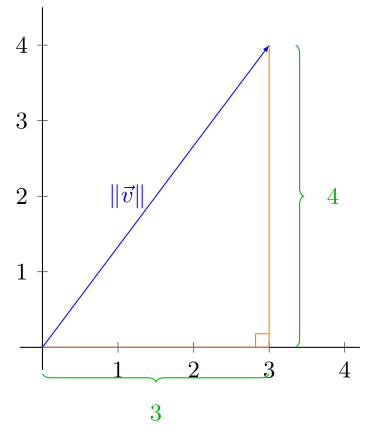
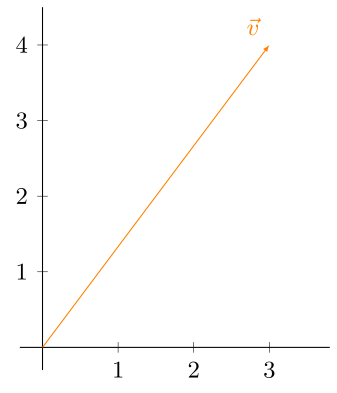
Ex: Given v=[34], normalize v.
Recall ∥v∥=5. We want to find a scalar c such that ∥cv∥=1. Using the result from above, ∥cv∥=∣c∣∥v∥, so we need ∣c∣⋅5=1, giving c=51=∥v∥1. Applying this:
v^=∥v∥1v=51[34]=[3/54/5]
This is the unit vector of v: it points in the same direction as v, but has length 1.
Goal: Given two vectors u & v, find a formula for the angle θ between them directly from their components, without needing to draw a picture.
To do this, we will use the vector u−v as the third side of the triangle formed by u and v, then apply the Law of Cosines. Recall given vectors u & v, the vector going from the tip of v to the tip of u is u−v.
We will now apply the Law of Cosines to the triangle formed by u, v, and u−v, using the three side lengths ∥u∥, ∥v∥, and ∥u−v∥.
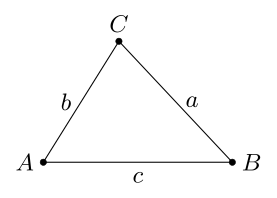
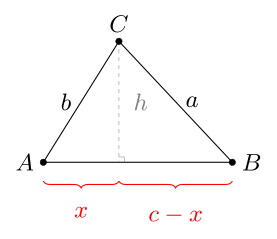
We want to express a2 in terms of b, c, and the angle A. The trick is to drop a perpendicular (altitude) from vertex C down to side AB, which splits the triangle into two right triangles. Calling the foot of the altitude H, let x=AH (the horizontal distance from A to H) and h=CH (the height). Then we can apply the Pythagorean Theorem to each right triangle separately:
(Acute triangle)
From the left right triangle (legs x and h, hypotenuse b):
x2+h2=b2⟹h2=b2−x2
From the right right triangle (legs c−x and h, hypotenuse a):